Why Not Iran?
The Selective Conscience of the Modern Campus

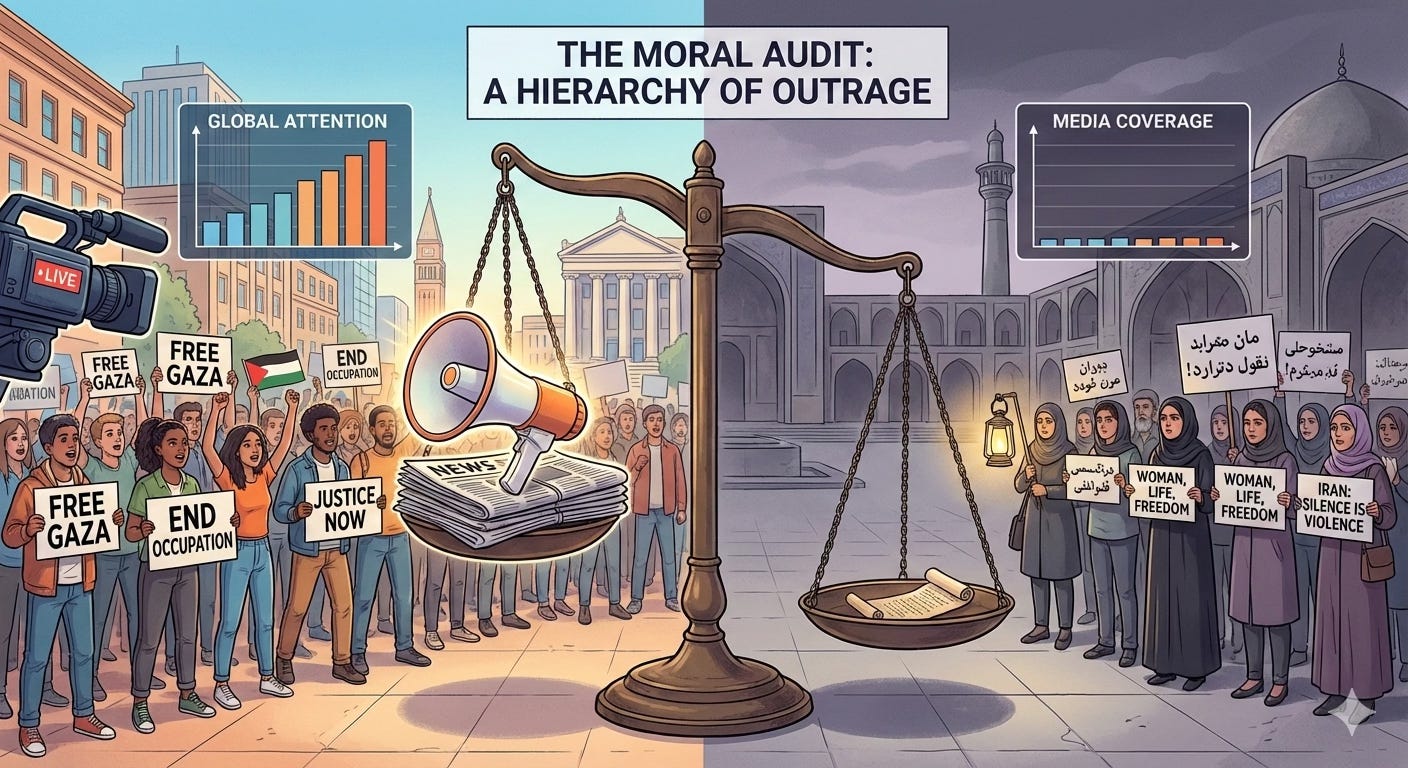
The Silence of the Campuses
As students return from winter break in early 2026, a strange silence hangs over American college campuses. Why are these spaces not erupting in protest against the slaughter of innocent civilians by an oppressive Iranian regime? What is the functional difference between the tragedies in Gaza and those in Iran?
For decades, we have been told that the protests spilling across Western cultures are fundamentally about fighting oppression. Yet, despite estimates of deaths in Iran ranging from thousands to tens of thousands since December 2025, the “outrage machine” remains silent. This discrepancy is a clue into the true aims of modern protest culture. While there is a target of oppression, it is a very specific type: Western Civilization.
The Selective Lens of Oppression
Protests in Iran target Islamic oppression, not the “Western, white supremacist, or patriarchal” structures that modern activists are trained to fight. Because certain Islamist movements position themselves against Western nations and ideals, they are often viewed as a “friend” through the logic of a common enemy.
This pattern of selective outrage repeats across the major social movements of the past decades:
Domestic Discrepancy: The Black Lives Matter movement focused on police brutality specifically when the victim was Black. While George Floyd’s death sparked a global movement, Tony Timpa—who died with a knee on his neck in a nearly identical manner—remains unknown. The outrage was not triggered by the act of brutality itself, but by the identity of the actors involved.
The Timing of Anti-Israel Protests: Protests erupted against Israel the day after they were invaded, long before they had a chance to militarily respond. Because Israel is viewed as an outpost of Western values, it is reflexively cast as the antagonist, regardless of the scale of the threats it faces.
Institutional Bias: We see this in the media’s “verification” standards. NPR shares the numbers of dead in Iran but reminds its audience they are “unverified,” yet they rarely qualify the numbers produced by Hamas in Gaza. Similarly, the New York Times has highlighted children in Gaza with cerebral palsy as victims of starvation without investigating why their siblings appear healthy.
The Moral Audit: Reclaiming “Whataboutism”
In modern debate, “whataboutism” is treated like a conversational ejector seat—a way to end a discussion the moment a contradiction is exposed. But we need to stop viewing it as a fallacy and start seeing it for what it truly is: the ultimate diagnostic tool.
Consistency is the tax you pay for moral authority. If your outrage is conditional, it isn’t based on a principle; it’s based on a preference. When we ask “What about Iran?”, we aren’t deflecting from Gaza; we are auditing the integrity of the protester’s value system.
The Hierarchy of Silence
Values do not exist in a vacuum; they exist in a hierarchy. If an individual is incensed by one tragedy but indifferent to another of equal or greater scale, they have revealed their “hidden settings.”
The hard truth: If you only care about oppression when the “Western world” is the perpetrator, you don’t actually hate oppression—you just hate the West.
By using the “whataboutism” lens, we force a confrontation with the “Why?”
Why does a life in Tehran weigh less than a life in Gaza?
Why is a death at the hands of a Western police officer a global emergency, while a death at the hands of an Islamist regime is a “complex local issue”?
The Algorithmic Void
One reason we avoid these comparisons is that they reveal a hollow core. Most people aren’t operating from a reasoned moral philosophy. Instead, they are operating from a reactive, bottom-up algorithm.
Human beings like to believe their views are the result of logic, but most of what we think is a product of our environment and personality types. Reason is often used only after the fact to justify views we already hold. Truly reasoned stances require the grueling work of identifying a flaw in your own logic and having the courage to adjust.
The vast majority of us don’t do that work. If you asked most people, “What is at the core of your views on human nature?”, they would have no answer. Until we address that void, our protests will continue to be more about tribal identity than universal human rights.